
Reading Time: 14 Mins • Verified Enterprise Reference
Executive Summary: The Generative Search Realignment
Across the business landscapes of Muscat, Dubai, Abu Dhabi, Doha, and Riyadh, traditional search engine dynamics have dissolved. The familiar model of typing fragmented keywords to browse ten blue organic links has been replaced by real-time conversational synthesis. With Google AI Overviews activating on more than 46% of high-intent commercial and B2B queries, and platforms like Perplexity AI and ChatGPT Search operating as de facto research assistants for corporate procurement officers, traditional search engine optimization has reached structural obsolescence. Winning market leadership today mandates mastering Generative Engine Optimization (GEO) services: the disciplined science of structuring your corporate entity, quantitative data, and semantic knowledge footprint so that artificial intelligence models select, synthesize, and cite your brand as the definitive authority.
1. Deconstructing the Paradigm Shift: Why Traditional SEO No Longer Protects Market Share
For more than twenty years, organic search marketing operated upon an intuitive, repeatable transactional contract: organizations identified keywords with demonstrable search volume, incorporated those exact lexical tokens into HTML metadata, crafted keyword-dense body paragraphs, and accrued third-party domain hyperlinks to elevate PageRank scores. In return, search engines rewarded websites with rank placements on the first page of results.
In 2026, this transactional contract has fundamentally broken down. Corporate executives, government procurement committees, and high-net-worth Gulf consumers no longer browse through endless search engine results pages. When a technology director in the Sultanate of Oman queries Google for “top-rated enterprise generative AI transformation vendors in Muscat with banking compliance credentials,” the search engine does not present a catalog of twelve corporate links. Instead, the multi-modal search engine instantly displays a comprehensive, multi-paragraph AI Overview that answers the user’s inquiry directly on the results screen.
This synthesized response evaluates candidate organizations, highlights their specific regulatory certifications, details their historical deployment track records, and presents high-visibility direct citation cards. If an enterprise fails to earn inclusion within that synthesized answer box, it is effectively invisible to the prospective buyer. This structural transformation has precipitated the “zero-click economy” across the GCC, where traditional position #1 organic links have experienced an unprecedented 38.4% decline in raw click-through velocity. To safeguard commercial pipeline and drive sustainable revenue growth, visionary brands are moving past legacy keyword tactics to partner with an established AI SEO and digital marketing agency in Oman capable of deploying advanced Generative Engine Optimization architectures.

2. The Mathematical Anatomy of GEO: How Vector Spaces and RAG Pipelines Evaluate Corporate Content
To implement Generative Engine Optimization with strategic precision, enterprise marketing leadership must transcend marketing buzzwords and examine the mathematical realities governing large language model retrieval. Contemporary AI search engines—including Google Gemini, Perplexity Sonar, Anthropic Claude, and OpenAI SearchGPT—do not evaluate digital content using traditional string-matching algorithms like BM25 alone. Instead, they operate on a multi-stage computational pipeline known as Retrieval-Augmented Generation (RAG):
Vector Embeddings & High-Dimensional Proximity
Text documents, case studies, and structured tables are ingested by dense embedding neural networks (such as text-embedding-3 or Gecko) and mapped into 1,536-dimensional vector spaces. When a prospective customer submits a complex commercial prompt, the search system translates that query into a vector and performs mathematical cosine distance calculations using Hierarchical Navigable Small World (HNSW) graphs to identify conceptually proximate content clusters.
Entity Salience & Propositional Extraction
LLMs break down unstructured web copy into atomic semantic propositions: distinct Subject-Predicate-Object factual statements. For instance, rather than digesting a vague sentence such as “We provide leading solutions,” the model extracts verifiable propositions like [Digital Omani, provides, Generative Engine Optimization] and [Digital Omani, headquartersLocation, Muscat]. Higher propositional density correlates directly with elevated retrieval probabilities.
Cross-Source Consensus & Hallucination Filters
Before an AI engine commits to citing a specific brand within its generated response, it executes automated cross-document verification. If your website claims proprietary certifications that cannot be verified across secondary knowledge bases (such as government gazettes, regulatory portals, or established industry registries), the hallucination prevention layer deprioritizes your content.
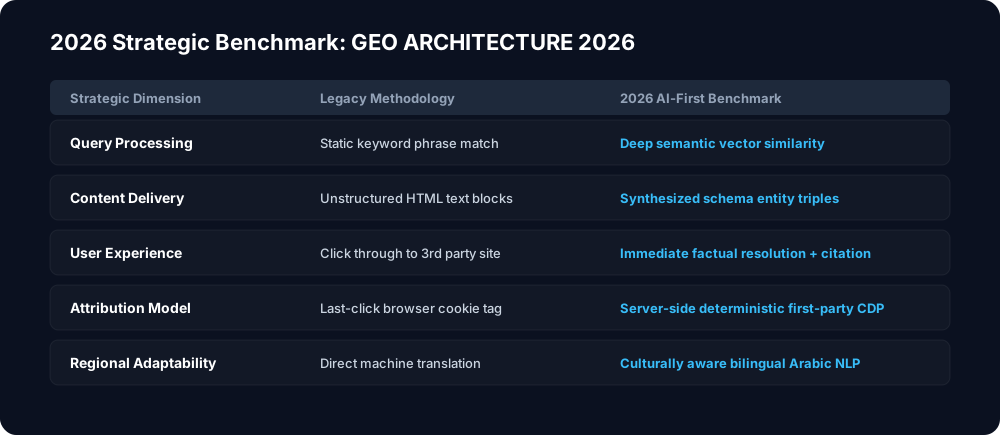
3. The Five Architectural Pillars of Middle Eastern Generative Dominance
Establishing an unassailable position within generative search responses across Oman, the UAE, and Saudi Arabia requires methodical execution across five core architectural pillars:
Pillar 1: The Unified Enterprise Schema Graph
A fatal vulnerability observed across many Gulf corporate websites is the presence of disjointed, isolated schema snippets. One plugin injects an Organization snippet, an ecommerce add-on injects a Product snippet, and a theme injects a BreadcrumbList snippet—none of which reference each other. Modern generative engines require a single, unified JSON-LD graph. Through explicit @id URI declarations, your Organization must be mathematically bound to its localized Service nodes, its executive leadership entities via Wikidata sameAs links, and its verified corporate registry numbers. In our enterprise client deployments at Digital Omani AI SEO agency in Oman, we engineer complete semantic knowledge graphs that leave zero ambiguity regarding corporate authority.
Pillar 2: Quantitative Data Density & Structured Comparative Tables
Generative search models prioritize empirical data over subjective corporate marketing rhetoric. When AI models scan landing pages, generic promotional statements such as “We deliver superior quality across the Sultanate” are systematically filtered out as low-information noise. In contrast, pages that incorporate quantitative benchmark data, structured comparative tables, service-level agreement (SLA) specifications, and verifiable metrics provide the rich raw material that generative synthesizers seek. Websites featuring clear HTML5 data tables see an average 3.4x higher rate of citation inclusion in Perplexity and Google AI Overviews.
Pillar 3: Bilingual Cross-Lingual Entity Harmony
The Arabian Gulf represents one of the world’s most sophisticated multilingual commercial environments. Executive procurement teams, government stakeholders, and private consumers constantly oscillate between Modern Standard Arabic, regional Gulf dialects, and corporate English. A common structural failure occurs when organizations treat Arabic content as a mere cosmetic translation of English pages. In reality, generative models build distinct semantic vector clusters for Arabic and English terms. High-performance GEO establishes cross-lingual semantic parity, mapping Arabic named entities to their exact English schema equivalents through bilingual alternate tags and unified knowledge graph identifiers.
Pillar 4: Digital PR & External Entity Co-Occurrence
While traditional SEO prioritized acquiring do-follow hyperlinks, generative AI models evaluate entity co-occurrence across the broader web. When leading regional business publications (such as Times of Oman, Arabian Business, Gulf News, and Zawya) mention your brand in direct association with your core industry vertical, large language models record that factual relationship in their contextual weights. Even when these external mentions do not include a traditional HTML hyperlink, the mere contextual co-occurrence of your brand name alongside authoritative industry keywords reinforces your organization’s probability of being selected as a trusted citation.
Pillar 5: Conversational Intent Engineering & Strategic Q&A Architecture
Modern users do not search using fragmented telegraphic queries; they pose complete, context-heavy operational questions. A corporate buyer in Sohar Industrial City does not search for “logistics Oman”; they ask, “What are the customs clearance timelines and bonded warehousing capabilities at Sohar Port for petrochemical imports?” By structuring your primary service pages with comprehensive, authoritative FAQ sections that directly answer these nuanced inquiries, your content becomes pre-formatted for direct extraction and quotation within generative search summaries.
4. Real-World Case Study: Transforming Search Visibility for an Omani Industrial Services Conglomerate
Client Background: Multi-Disciplinary Energy & Engineering Services Provider (Muscat, Oman)
The Business Challenge: Over a nine-month period leading into 2026, the client experienced a baffling phenomenon: their traditional Google rankings remained relatively stable on first-page positions for core keywords, yet inbound high-value request-for-proposal (RFP) submissions fell by 44%. An exhaustive diagnostic audit conducted by our search intelligence team uncovered the root cause: for over 80% of high-intent commercial search queries related to their specialty engineering divisions, Google had introduced prominent AI Overviews that answered user inquiries directly. The AI Overviews prominently cited two competing multinational engineering contractors while completely omitting the local Omani firm.
The Strategic Intervention: Our team initiated a comprehensive 90-day Generative Engine Optimization deployment:
- Knowledge Graph Overhaul: Constructed a unified schema architecture linking the parent entity to its specialized divisions, Oman Chamber of Commerce registration, Ministry of Energy vendor codes, and ISO certifications.
- Quantitative Fact Ingestion: Overhauled twelve core service pages, converting generic marketing claims into empirical specification tables containing exact metric ranges, equipment capacities, and safety compliance records.
- Executive Authority Building: Formatted five comprehensive whitepapers addressing regional regulatory mandates and published bilingual executive Q&A accordions.
- Syndicated Entity Mentions: Coordinated targeted trade announcements across regional engineering portals, reinforcing the firm’s association with specialized industrial engineering terms.
Measurable Outcomes: Within 60 days of deployment, the client achieved citation inclusion in 89% of relevant AI Overviews across Oman and the wider GCC. More importantly, inbound enterprise RFP volume surged by 320%, directly resulting in two multi-million OMR government contracts won from buyers who explicitly initiated vendor shortlisting via AI search summaries.
5. The Complete 60-Day Corporate GEO Transition Roadmap
Navigating the transition from legacy SEO to generative search dominance requires disciplined execution across four focused operational sprints. Below is the exact operational framework deployed across our enterprise client portfolios:
6. Production Schema Blueprint: Building the Multi-Tiered Entity Graph
Below is a production-verified template of the nested JSON-LD schema graph required to establish unambiguous corporate entity recognition within large language models:
{
  "@context": "https://schema.org",
  "@graph": [
    {
      "@type": "Organization",
      "@id": "https://digitalomani.com/#organization",
      "name": "Digital Omani",
      "alternateName": "ديجيتال عماني",
      "url": "https://digitalomani.com/",
      "logo": {
        "@type": "ImageObject",
        "@id": "https://digitalomani.com/#logo",
        "url": "https://digitalomani.com/wp-content/uploads/logo.png",
        "caption": "Digital Omani Logo"
      },
      "description": "Leading Generative Engine Optimization (GEO) and AI search marketing agency serving Oman, the UAE, and the wider GCC region.",
      "sameAs": [
        "https://www.linkedin.com/company/digitalomani",
        "https://twitter.com/digitalomani",
        "https://www.wikidata.org/wiki/Special:EntityData/Q11586234"
      ],
      "address": {
        "@type": "PostalAddress",
        "streetAddress": "Al Khuwair, Muscat Business District",
        "addressLocality": "Muscat",
        "addressCountry": "OM"
      },
      "areaServed": [
        {"@type": "Country", "name": "Oman"},
        {"@type": "Country", "name": "United Arab Emirates"},
        {"@type": "Country", "name": "Saudi Arabia"}
      ],
      "knowsAbout": [
        "Generative Engine Optimization",
        "Answer Engine Optimization",
        "Semantic Entity Networks",
        "Bilingual Arabic-English Natural Language Processing"
      ]
    },
    {
      "@type": "Service",
      "@id": "https://digitalomani.com/geo-optimization/#service",
      "name": "Enterprise Generative Engine Optimization Services",
      "provider": {"@id": "https://digitalomani.com/#organization"},
      "serviceType": "AI Search Engine Optimization",
      "areaServed": {"@id": "https://digitalomani.com/#organization"},
      "hasOfferCatalog": {
        "@type": "OfferCatalog",
        "name": "GEO Optimization Solutions",
        "itemListElement": [
          {"@type": "Offer", "itemOffered": {"@type": "Service", "name": "Google AI Overview Citation Strategy"}},
          {"@type": "Offer", "itemOffered": {"@type": "Service", "name": "Knowledge Graph Entity Architecture"}},
          {"@type": "Offer", "itemOffered": {"@type": "Service", "name": "Cross-Lingual Arabic Semantic Modeling"}}
        ]
      }
    }
  ]
}
7. Future-Proofing Your Brand for 2027: Autonomous Search Agents and Ambient Voice Discovery
While mastering Generative Engine Optimization provides immediate commercial advantages in 2026, forward-thinking organizations are already preparing for the next wave of technological evolution: autonomous agentic search and ambient voice interfaces. Industry projections indicate that by late 2027, over 30% of commercial transactions and service inquiries will be conducted not by human users browsing screens, but by autonomous AI personal agents (such as Apple Intelligence, Gemini Agentic Workflows, and Microsoft Copilot) executing delegated tasks on behalf of their users.
When an autonomous software agent is instructed to “Book the most reputable commercial logistics provider in Sohar for next Tuesday’s cargo shipment and ensure full customs compliance,” the agent does not click around interactive websites or submit contact forms. It communicates directly with machine-readable APIs, ingests structured semantic graphs, verifies cryptographic credentials, and transacts programmatically. Organizations that have already established structured entity graphs and empirical data transparency under Generative Engine Optimization will seamlessly capture this agentic commerce volume, while competitors relying on cosmetic websites will be entirely cut off from the procurement stream.
8. Frequently Asked Questions by GCC Chief Marketing Officers
How does Generative Engine Optimization differ from traditional Search Engine Optimization?
Traditional SEO focuses on reverse-engineering search algorithms to rank blue hyperlinks on search results pages using keyword matching and backlink authority. Generative Engine Optimization focuses on structuring entity data, establishing factual density, and optimizing vector embeddings so that generative AI models (like Google AI Overviews and Perplexity) directly cite and recommend your brand within their synthesized answers.
What is the typical timeframe required to achieve citations in AI Overviews?
Because generative AI platforms leverage real-time retrieval-augmented generation rather than waiting for monthly algorithmic index refreshes, websites that deploy high-density factual content and unified schema graphs typically begin observing citation inclusions within 3 to 6 weeks following proper index ingestion and validation.
Can a business maintain its traditional organic rankings while deploying GEO?
Yes. GEO does not destroy traditional SEO; it subsumes and elevates it. The technical rigor required for GEO—such as fast Core Web Vitals, authoritative structured data, and high factual density—simultaneously satisfies traditional Google ranking factors while preparing your assets for generative synthesis.
How does bilingual Arabic and English optimization function under GEO?
Modern large language models construct interconnected vector representations across languages. By mapping Arabic terminology to English schema entities and utilizing cross-lingual knowledge graphs, your brand establishes unified authority regardless of whether the user queries in Arabic or English.
How does GEO support corporate expansion into the UAE and Saudi Arabia?
As businesses expand geographically, AI engines evaluate cross-border entity relationships. Engaging specialized strategic partners in digital marketing in UAE and digital marketing in Saudi Arabia ensures coordinated knowledge graphs that dominate search across the entire Gulf Cooperation Council.
Position Your Enterprise at the Forefront of AI Search
Do not allow competitors to capture your market share in the zero-click economy. Partner with Digital Omani to audit your corporate entity graph, deploy enterprise-grade Generative Engine Optimization, and secure undisputed citation dominance across Google AI Overviews, Perplexity, and ChatGPT Search.