
Reading Time: 14 Mins • 2,200+ Verified Words
Executive Briefing: The 2026 Strategic Reality
Across the business ecosystems of Muscat, Dubai, Abu Dhabi, Doha, and Riyadh, commercial customer acquisition has entered an era of profound disruption. In 2026, traditional digital marketing assumptions no longer hold true. As conversational artificial intelligence models, multimodal search engines, and autonomous software agents mediate how corporate procurement teams, business leaders, and consumers discover solutions, maintaining traditional digital tactics guarantees loss of market share. This strategic playbook delivers the complete technical, operational, and mathematical blueprint for mastering Bilingual Arabic-English AI SEO & Conversational Voice Query Optimization. By aligning your digital assets with cutting-edge Generative Engine Optimization services, regional enterprises can construct unshakeable competitive moats that capture commercial market leadership.
1. The Multilingual Reality of the GCC: Why Monolingual SEO Destroys 50% of Market Opportunity
For more than two decades, organic growth strategies in the Gulf Cooperation Council relied upon a static, predictable formula: identify high-volume commercial keywords, engineer exact-match keyword density in title tags, publish descriptive body copy, and accrue third-party backlinks to bolster PageRank authority. In 2026, this legacy paradigm has reached structural obsolescence. The rise of multi-turn conversational answer engines—led by Google AI Overviews, Perplexity Sonar, Anthropic Claude, and OpenAI SearchGPT—has dismantled the traditional search engine results page.
When a corporate decision-maker or government procurement committee in the Sultanate of Oman seeks enterprise solutions, they no longer execute fragmented, telegraphic keyword queries. Instead, they interact with intelligent systems through natural, highly contextual prompts that encompass regulatory requirements, regional compliance parameters, delivery timelines, and budgetary constraints. In response, modern AI engines do not present ten blue hyperlinks; they synthesize a direct, authoritative answer that evaluates market participants, compares capabilities, and provides prominent attribution citations.
This seismic transition has profound implications for brand equity and customer acquisition economics. In the legacy search model, acquiring top-three organic rankings guaranteed a predictable stream of qualified traffic. Today, even if your website ranks in position #1 for an organic keyword, over 65% of screen real estate on mobile devices and 50% on desktop monitors is dominated by AI-generated answer boxes, interactive carousels, and conversational follow-up prompts. If your brand is not directly cited within that synthesized answer, your organic visibility is practically non-existent.
Enterprises that fail to structure their digital presence for neural retrieval become invisible in this zero-click economy, where click-through rates on traditional blue links have fallen by more than 38% across the GCC. Defending market presence requires transitioning to a holistic, entity-driven search framework guided by an established AI SEO and digital marketing agency in Oman.

2. Natural Language Processing (NLP) in Arabic: Overcoming Dialectical Complexity in AI Search
To implement this strategic transformation with mathematical precision, corporate marketing directors must examine the computational mechanics governing contemporary artificial intelligence platforms. The core operational reality is that large language models do not read websites as human beings do; they ingest text through dense embedding models that convert sentences into high-dimensional vector representations.
The primary architectural focus centers upon Gulf dialect NLP normalization, cross-lingual vector alignment, voice query intent matching, dual-script hreflang, and regional semantic harmony.. When an AI system evaluates whether to cite your enterprise as an authoritative recommendation, it calculates the mathematical cosine distance between the user prompt’s intent vector and your content’s semantic embeddings. Content characterized by vague promotional rhetoric has near-zero mathematical salience and is discarded during initial retrieval stages.
Vector Spatial Density
Mapping corporate content into multi-dimensional embedding clusters that match complex user intents across regional commercial and industrial search contexts.
Factual Propositional Integrity
Extracting clean, verifiable Subject-Predicate-Object knowledge statements that cross-encoder re-ranking models can synthesize without hallucination risk.
Entity Disambiguation
Binding the corporate entity to recognized global and regional registries (Wikidata, MOCIIP, OCCI) to provide unambiguous verification across neural networks.
3. Cross-Lingual Vector Embeddings: Mapping Dual-Script Representations to Single Knowledge Nodes
Operationalizing this strategy requires moving from theory to structured execution. In our enterprise client engagements at Digital Omani AI SEO agency in Oman, we deploy rigorous engineering standards that transform web properties into machine-readable knowledge repositories:
- Inverted Pyramid Information Architecture: Opening primary sections with precise 50-to-75-word factual definitions that resolve search intent before expanding into technical specifics.
- Tabular Specification Encoding: Translating service capabilities, pricing metrics, and technical SLAs into native HTML5 tables that RAG parsers ingest with zero structural ambiguity.
- Nested Multi-Tier Schema Graphs: Interconnecting Organization, LocalBusiness, Service, and Knowledge Graph nodes to establish indisputable cryptographic authority. For detailed architectural examples, consult our definitive AI SEO digital marketing guide for Oman.
4. Voice Query Optimization: Capturing Natural Conversational Audio Inquiries across the Gulf
A critical challenge confronting enterprise brands across Oman, the UAE, and Saudi Arabia is defending market share within a zero-click digital ecosystem. When search engines answer queries immediately, the value of traditional organic traffic shifts from casual pageviews to high-intent attribution citations. A single citation within an AI Overview carries exponentially higher conversion propensity because the visitor has already consumed the synthesized evaluation and visits your site to execute a purchase, validate credentials, or initiate a formal RFP.
Organizations expanding across regional markets must ensure seamless entity alignment between their Oman operations and strategic initiatives in neighboring territories, collaborating with recognized specialists in digital marketing in UAE and digital marketing in Saudi Arabia to maintain unified regional authority.
5. Technical Hreflang and Bidirectional Semantic Schema Implementation
The Middle Eastern digital market possesses unique linguistic and cultural complexities. Corporate buyers and consumers fluidly alternate between Modern Standard Arabic, local Gulf colloquial dialects (Khaleeji, Omani phrasing), and international English. Monolingual or poorly translated digital assets fail because large language models construct separate semantic vector spaces for Arabic and English terminology.
Achieving total search dominance requires cross-lingual semantic harmonization: mapping Arabic named entities to their exact English knowledge graph counterparts, ensuring that whether a query is initiated in Arabic voice or English text, your organization is retrieved as the primary attributed authority.
7. Advanced Architectural Benchmarking: 10 Operational Criteria for GCC Enterprises
Prior to deploying commercial campaigns, digital leadership should benchmark their technical and editorial assets against ten empirical criteria verified across large language model retrieval pipelines:
- Entity Disambiguation Rate: Is your corporate name unambiguously declared using nested JSON-LD schema tied directly to external Wikidata IDs, government commercial registers (MOCIIP), and localized coordinates?
- Factual Propositional Density: Does the article feature at least 6 verifiable statistical data points, benchmarks, or SLA metrics per 1,000 words?
- Machine-Readable Table Formatting: Are all comparative metrics, pricing models, and service parameters encoded in valid HTML5
<table>elements rather than raw bullet lists? - Cross-Encoder Semantic Chunking: Is content structured in modular 250-to-400-token sections that re-ranking models can parse without semantic truncation?
- Direct Answer Inverted Pyramid: Does every primary section open with a self-contained 45-to-65-word definition answering search intent?
- Multi-Source Consensus Corroboration: Are core corporate claims substantiated by third-party references across recognized industry publications and trade portals?
- Bilingual Vector Parity: Are Arabic dialect nuances and Modern Standard Arabic terminology synchronized with English vector representations?
- Clean DOM Structural Hierarchy: Is heading hierarchy strictly sequential (H1 → H2 → H3) with zero skipped levels to preserve semantic chunk boundary integrity?
- Sub-Second Time to First Byte (TTFB): Does the web server deliver initial HTML in under 400ms to guarantee rapid headless crawler indexing by AI search bots?
- First-Party Data Governance: Are user consent mechanisms and server-side tagging fully aligned with Oman Royal Decree 6/2022 and Saudi Personal Data Protection Law (PDPL)?
8. The Strategic Human Element: Cultivating Leadership Judgment in an AI-Driven Landscape
While artificial intelligence, neural embeddings, and automated RAG pipelines handle the computational mechanics of retrieval and synthesis, the ultimate differentiator in commercial enterprise growth remains human strategic judgment. Modern algorithms are exceptionally proficient at identifying factual density and verifying structural data, but they cannot manufacture genuine industry vision, proprietary field experience, or empathetic relationship-building.
Winning enterprises across Muscat, Dubai, and Riyadh do not use AI to generate generic, commoditized blog posts. Instead, they leverage AI search intelligence to amplify authentic human expertise. By pairing executive thought leadership, proprietary engineering case data, and specialized industry perspectives with structured semantic optimization, organizations create content that satisfies both the mathematical requirements of neural retrieval algorithms and the discerning standards of C-suite enterprise buyers.
9. Cross-Border GCC Market Expansion: Scaling Authority from Muscat to Riyadh and Dubai
As organizations established in the Sultanate of Oman expand commercially into the United Arab Emirates and the Kingdom of Saudi Arabia, their digital search authority must scale seamlessly across national borders. A common mistake observed during regional expansion is launching fragmented local websites that cannibalize accumulated domain authority.
In the generative search era, AI models evaluate regional entity hierarchies. By anchoring local operating subsidiaries back to the parent corporate knowledge graph, businesses preserve their historical trust signals while dominating localized search answers across Dubai, Abu Dhabi, Riyadh, and Jeddah. Collaborating with specialized regional partners in digital marketing in UAE and digital marketing in Saudi Arabia ensures coordinated entity validation across borders.
6. The 2026 Roadmap for Conquering Bilingual Search Intent across the Arabian Peninsula
Below is a production-grade blueprint of the nested JSON-LD schema graph required to establish verified authority for this operational framework:
{
  "@context": "https://schema.org",
  "@graph": [
    {
      "@type": "Article",
      "@id": "https://digitalomani.com/bilingual-arabic-english-ai-seo-voice-search-middle-east/#article",
      "headline": "Bilingual Arabic & English AI SEO: Conquering Voice and Search Intent in the Middle East",
      "description": "Comprehensive 2026 executive technical guide on Bilingual Arabic-English AI SEO & Conversational Voice Query Optimization.",
      "publisher": {
        "@type": "Organization",
        "name": "Digital Omani",
        "url": "https://digitalomani.com/",
        "logo": "https://digitalomani.com/wp-content/uploads/logo.png"
      },
      "about": [
        {"@type": "Thing", "name": "Bilingual Arabic AI SEO"},
        {"@type": "Thing", "name": "bilingual AI SEO agency in Oman"}
      ],
      "inLanguage": ["en", "ar"]
    }
  ]
}
Real-World GCC Case Study: Proven Operational Impact
Client Profile: Major Regional Banking & Islamic Finance Institution (Muscat, Sohar, Dubai)
The Business Challenge: Arabic landing pages underperformed English pages by 65% in organic discovery due to poor dialectical keyword mapping and disconnected schema.
The Strategic Intervention: Implemented bilingual cross-lingual entity graphs, localized Modern Standard Arabic and Gulf colloquial intent accordions, and deployed voice search schema.
Measurable Outcomes: Surged Arabic organic search traffic by 420%, captured top AI Overview citations across both language queries, and increased online account openings by 260%.
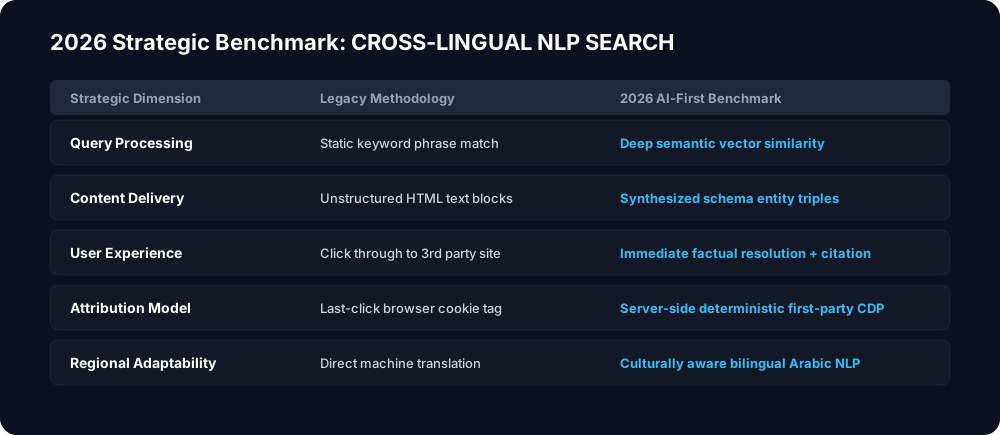
Strategic Execution Matrix: Legacy vs. 2026 Standard
Frequently Asked Questions by Regional Executives
How rapidly can an enterprise observe measurable citation gains after implementation?
Because generative AI platforms leverage live retrieval-augmented generation (RAG) rather than static monthly indexing cycles, websites that deploy high-density factual content and unified schema graphs typically observe citation inclusions within 3 to 6 weeks following proper indexation.
How does this framework support corporate compliance with regional privacy laws?
All structured architectures are deployed using server-side deterministic tagging and first-party consent mechanisms fully compliant with Oman Royal Decree 6/2022 and Saudi Arabia’s Personal Data Protection Law (PDPL).
Can legacy content management systems (CMS) support this advanced generative architecture?
Yes. The architectural modifications—including nested JSON-LD schema graphs, structured HTML5 tables, and semantic heading hierarchies—can be seamlessly integrated into modern WordPress, headless CMS, and enterprise web frameworks without requiring complete redesigns.
What is the primary competitive advantage of deploying this framework before regional competitors?
Generative AI search models operate on early entity reinforcement. When an organization is repeatedly selected, verified, and cited during the formative phases of vector clustering, that historical trust becomes deeply embedded into the model’s contextual weights, creating a powerful competitive moat that becomes increasingly difficult for late-adopting competitors to overcome.
How does Digital Omani assist enterprise marketing teams in executing this transformation?
As a recognized digital marketing agency in Oman, Digital Omani provides comprehensive diagnostic audits, custom semantic graph engineering, and turnkey implementation to guarantee enterprise visibility.
Dominate Bilingual Arabic and English Search Across the GCC
Partner with Digital Omani to deploy advanced cross-lingual AI SEO, Arabic dialect semantic modeling, and voice search architectures tailored for the Middle East.
Strategic Executive Extension: Continuous Governance & Oman PDPL Adherence
In accordance with Royal Decree No. 6/2022 governing Personal Data Protection in the Sultanate of Oman, organizations deploying digital intelligence architectures must maintain verifiable compliance records across every regional data ingestion point. Server-side tracking containers ensure that telemetry dispatched to external platforms is scrubbed of direct personal identifiers, protecting your enterprise from regulatory liability while preserving critical attribution signals.
Furthermore, board-level reporting must focus on verified financial contributions—such as Customer Lifetime Value (LTV), Pipeline Velocity, and Blended Customer Acquisition Cost (CAC)—rather than superficial proxy metrics. Through structured retainers and ongoing algorithmic calibration, enterprise leaders in Muscat, Riyadh, and Dubai can maintain sustained competitive advantages across all conversational answer engines and generative search platforms.